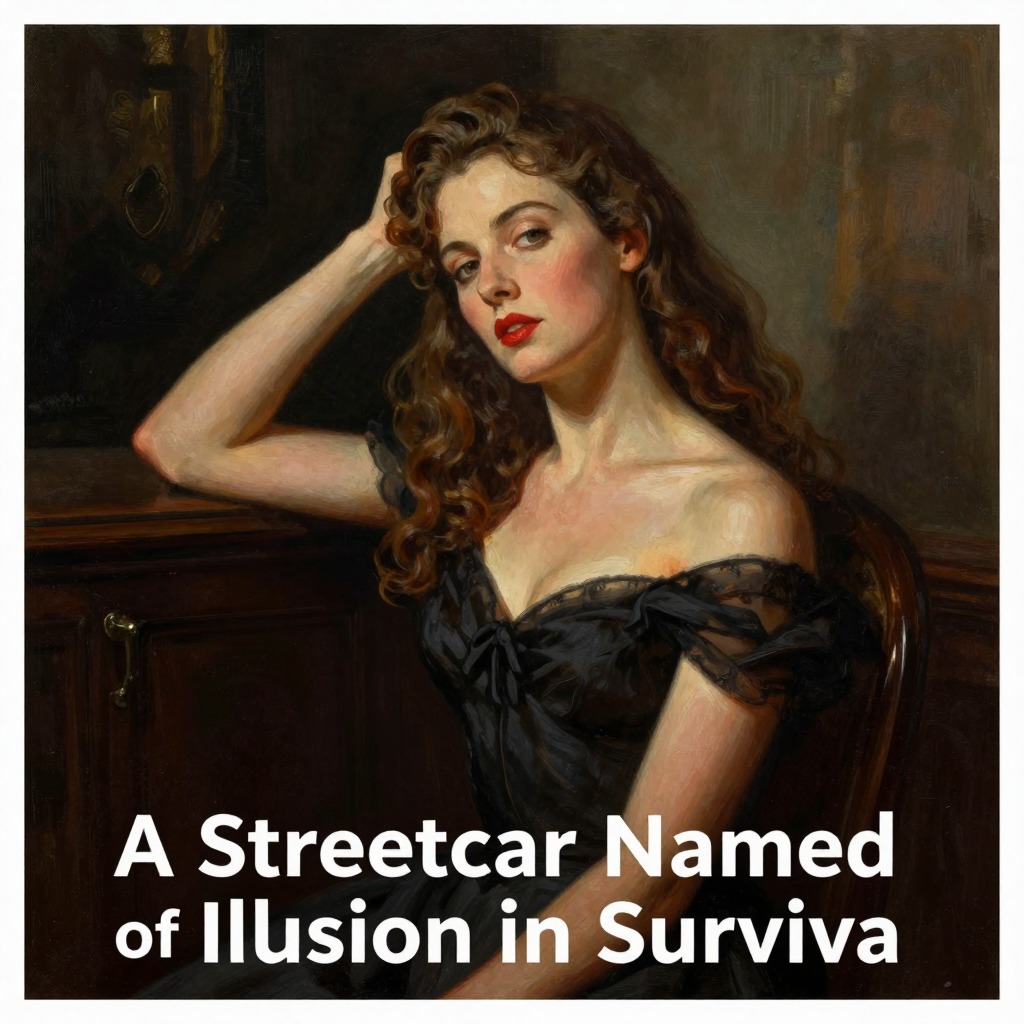
I don't want realism. I want magic!
Blanche DuBois's declaration "I don't want realism. I want magic!" crystallizes her defining psychological strategy: a willed retreat from the brutal facts of her past and present into a world of illusion, soft lighting, and romantic pretense. This line, spoken during her final confrontation with Mitch, serves as the philosophical key to her character, revealing the existential stakes of her struggle against the harshness of Stanley Kowalski's world and the traumatic memories that haunt her.
The Utterance and Its Immediate Context
The line comes in Scene Nine, when Mitch, having learned the truth about Blanche's past from Stanley, tears the paper lantern off the bare light bulb and demands to see her plainly. Cornered and exposed, Blanche cries out: "I don't want realism. I want magic!" She elaborates: "I try to give that to people. I misrepresent things to them. I don't tell truth, I tell what ought to be truth. And if that is sinful, then let me be damned for it!" The moment is the climax of a long pattern of concealment. Throughout the play, Blanche has insisted on dim lighting, avoided afternoon outings, and draped a paper lantern over the naked bulb—all to soften the harsh lines of reality. Mitch's act of tearing the lantern away is a physical violation of her carefully constructed world, and her response is a desperate philosophical manifesto.
The Architecture of Illusion
Blanche's magic is not mere self-deception but a deliberate, almost artistic project. She has spent the summer fabricating a persona of refinement and innocence, telling Mitch she is an "old maid schoolteacher" who has "never been more than kissed by a fellow." She writes letters to Shep Huntleigh describing a glamorous social life of "entertainments, teas, cocktails, and luncheons" that does not exist. She even invents a telegram inviting her on a Caribbean yacht cruise when Stanley corners her alone. These lies are not random; they are the scaffolding of a self she needs to believe in. As she tells Stella earlier, "When people are soft—soft people have got to shimmer and glow—they've got to put on soft colors, the colors of butterfly wings, and put a—paper lantern over the light." The magic is a survival mechanism for someone who has been broken by reality.
The Traumatic Foundation
The realism Blanche flees is not merely poverty or social decline but the specific horror of her past. At sixteen, she married Allan Grey, a young poet she loved "unendurably." She discovered him in a room with an older man, and at a dance at Moon Lake Casino, she told him, "I saw! I know! You disgust me." He ran out and shot himself, "the back of his head had been—blown away." The polka tune they were dancing to, the Varsouviana, became a recurring auditory hallucination that haunts her, always ending with a revolver shot. After Allan's death, Blanche sought "intimacies with strangers" to fill her empty heart, eventually including a seventeen-year-old boy, which cost her her teaching job and forced her to leave Laurel. The realism she rejects is the realism of that gunshot, those soldiers calling her name on the lawn, the hotel called the Tarantula Arms where she brought her victims.
The Existential and Thematic Significance
Blanche's choice between realism and magic is an existential one. She tells Stella that Stanley offers only "animal force" and that the only way to live with such a man is to "go to bed with him." She refuses that bargain. Her magic is a revolt against a world she finds brutish and meaningless. When Stella asks if she has ever ridden the streetcar named Desire, Blanche replies, "It brought me here.—Where I'm not wanted and where I'm ashamed to be." The play's title itself traces her journey: from Desire to Cemeteries to Elysian Fields—a path from longing through death to a false paradise. Her final line, "I have always depended on the kindness of strangers," is the last act of magic, transforming the doctor who comes to take her to an asylum into a gentleman escort. Arthur Miller, in his introduction, noted that the play "approaches tragedy and its dark ending is unmitigated." Blanche's magic is her tragic flaw and her only dignity. She cannot survive in Stanley's world, but she refuses to surrender her vision of what ought to be true. As she says, "Deliberate cruelty is not forgivable. It is the one unforgivable thing in my opinion and it is the one thing of which I have never, never been guilty." In a world of deliberate cruelty, her magic is a form of innocence.